Free Online Child Height Predictor & Growth Estimator
Every parent wonders how tall their child will grow to be when they reach adulthood. While genetic factors play a primary role in determining final adult stature, clinical pediatric formulas can accurately estimate potential growth ranges. Our free online child height predictor uses scientifically validated algorithms—including the Mid-Parental Height (Tanner) method and the Khamis-Roche growth model—to project your child’s adult height instantly. By factoring in parental heights, biological sex, current age, and present stature, this free online child height predictor provides clear, actionable growth insights for parents and caregivers.
Child Height Predictor
Estimate your child's likely adult height using the Mid-Parental Height method
How to Use the Free Online Child Height Predictor
- Select Biological Sex: Choose whether you are predicting adult height for a boy or a girl to apply the correct growth velocity baseline.
- Input Parents’ Heights: Enter the exact standing height of both the biological mother and biological father.
- Input Child’s Current Details (Optional): Enter your child’s current age, height, and weight for enhanced precision using advanced growth models.
- Calculate Predicted Height: Click process to let the free online child height predictor calculate the estimated adult stature and target range.
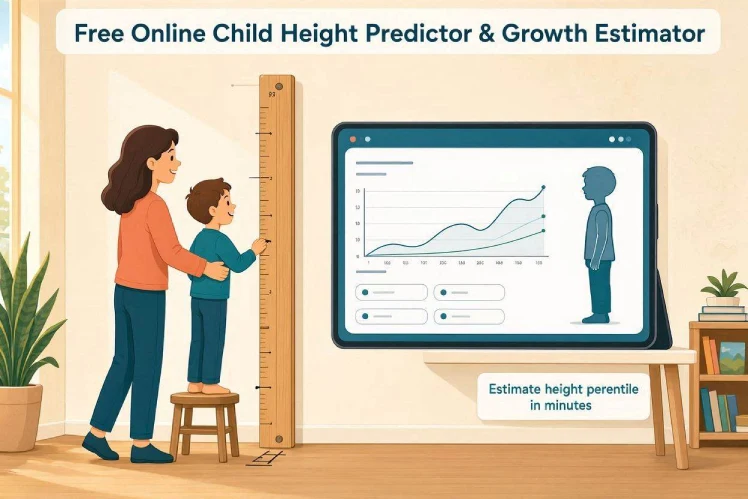
Why Use Our Free Online Child Height Predictor?
Estimating a child’s growth manually requires navigating complex pediatric formulas and converting measurements across imperial and metric systems. Our free online child height predictor automates these mathematical models, delivering instant, scientifically backed predictions without errors.
- Dual Scientific Calculation Models: Combines traditional Mid-Parental Height formulas with current growth trajectory analysis.
- Flexible Unit Measurement Support: Easily switch between Metric (centimeters and kilograms) and Imperial (feet, inches, and pounds) units.
- Gender-Specific Biological Adjustments: Accounts for distinct growth velocity curves and bone maturation rates between boys and girls.
- Clear Target Stature Ranges: Displays both the estimated peak adult height and the standard clinical deviation range (±2 inches / ±5 cm).
- 100% Free & Private Growth Tool: Estimate growth potential as many times as you like with zero account creation, subscription fees, or data collection.
The Science Behind Child Height Prediction Models
When reviewing the results from our free online child height predictor, your child’s projected stature is calculated using established clinical growth methodologies:
1. The Mid-Parental Height (Tanner) Method
Developed by pediatric endocrinologists, the Mid-Parental Height method calculates genetic potential based on the heights of both biological parents:
- For Boys:
[(Mother's Height + Father's Height + 5 inches) / 2](or+ 13 cmin metric). - For Girls:
[(Mother's Height + Father's Height - 5 inches) / 2](or- 13 cmin metric).
This formula establishes a “target height” with a normal biological variation window of ±2 inches (±5 cm), accounting for genetic diversity across siblings.
2. The Khamis-Roche Method
For children aged 4 and older, the Khamis-Roche growth model enhances accuracy by evaluating the child’s current standing height, current body weight, and average parental height. Clinical studies show that the Khamis-Roche model is one of the most accurate non-invasive predictors for children whose skeletal age aligns with their chronological age.
3. The Doubling Method (Toddler Rule of Thumb)
A simple, traditional heuristic frequently referenced in early pediatric care involves doubling a boy’s height at age 2, or doubling a girl’s height at age 18 months. While less precise than multi-variable mathematical models, it offers a quick general benchmark during early childhood.
Key Factors That Influence Final Adult Stature
While an algorithm on a free online child height predictor establishes the baseline genetic potential, several biological and environmental factors influence whether a child reaches the upper or lower boundaries of their growth curve:
1. Genetics & Hereditary Stature
Genetics account for approximately 60% to 80% of final adult height. Polygenic traits inherited from parents, grandparents, and extended family lines establish the physiological boundaries of bone growth.
2. Quality Nutrition & Caloric Intake
Proper nutrition during infancy and adolescent growth spurts provides essential building blocks for bone skeletal expansion. Adequate intake of calcium, vitamin D, zinc, protein, and essential micronutrients prevents stunted growth and supports optimal bone mineral density.
3. Adequate Sleep & Human Growth Hormone (HGH)
Human Growth Hormone (HGH) is primarily secreted by the pituitary gland during deep, slow-wave sleep cycles. Ensuring children maintain age-appropriate sleep schedules supports maximum natural hormone release during developmental years.
4. Physical Activity & Postural Health
Regular physical exercise stimulates bone density, supports healthy muscle attachment, and encourages proper spinal alignment during peak growth spurts.
When to Consult a Pediatrician About Growth Patterns
While minor variations above or below the predicted baseline generated by a free online child height predictor are entirely normal, significant deviations across pediatric growth percentile charts may warrant a professional clinical review. Pediatricians evaluate growth velocity (rate of growth over time) rather than isolated height measurements alone.
Factors such as delayed puberty, thyroid function, nutritional absorption, or hormonal imbalances can alter natural growth trajectories. A healthcare professional can perform a wrist X-ray to assess bone age (skeletal maturation) if formal growth tracking is recommended.
To explore more family wellness and financial planning calculators, test your health metrics with our Free Online BMI Calculator, plan savings with our Free Online RD Calculator, or visit our main Moral Story Homepage. For clinical background on pediatric growth standards, consult the World Health Organization (WHO) Child Growth Standards Guidelines.
Frequently Asked Questions (FAQ)
Is this free online child height predictor completely free?
Yes! You can use our free online child height predictor 100% free with no registration, subscriptions, hidden charges, or usage limits.
How accurate is an online child height prediction?
Clinical growth formulas typically predict adult height within a margin of ±2 inches (±5 cm). While genetics account for 60% to 80% of final height, environmental factors like nutrition, sleep, and physical activity influence actual growth outcomes.
Why is the calculation formula different for boys and girls?
Boys and girls follow distinct biological growth curves. On average, adult men are approximately 5 inches (13 cm) taller than adult women, and boys experience their peak adolescent growth spurt later than girls.
Does this tool store my child’s age or height data?
No. Your privacy is protected. All measurements entered into the tool are processed instantly inside your web browser and are never saved or recorded on external servers.
Can lifestyle changes make a child grow taller than their predicted height?
Ensuring optimal nutrition, 9–11 hours of quality sleep, regular exercise, and maintaining overall health helps a child reach the maximum upper limit of their genetic potential.