Free Online FD Calculator & Fixed Deposit Return Estimator
Fixed deposits (FDs) remain one of the most reliable, low-risk investment vehicles for preserving capital while generating guaranteed financial returns. However, manual calculation of compounding interest over varying tenures, payout frequencies, and bank interest rates can lead to errors. Our free online FD calculator simplifies wealth planning by computing accurate fixed deposit maturity values, interest payouts, and total investment growth instantly. Whether you are investing in short-term bank deposits, corporate FDs, or post office term schemes, this free online FD calculator provides clear financial clarity for smart money management.
FD (Fixed Deposit) Calculator
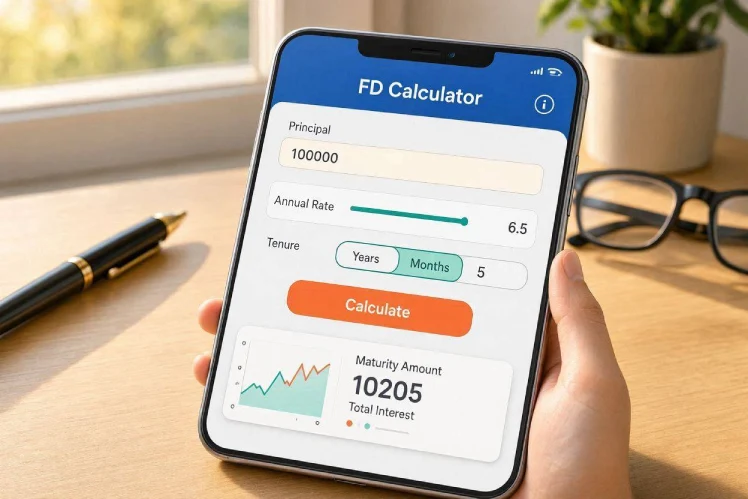
How to Use the Free Online FD Calculator
- Select Deposit Type: Choose between Cumulative FD (compounded growth at maturity) or Non-Cumulative FD (regular interest payouts).
- Input Principal Amount: Enter the total sum of money you plan to invest in your fixed deposit scheme.
- Set Annual Interest Rate: Enter the annual interest rate (% p.a.) offered by your bank or financial institution.
- Select Investment Tenure: Choose your deposit duration in days, months, or years.
- Calculate FD Returns: Click process to let the free online FD calculator generate your detailed maturity report.
Why Use Our Free Online FD Calculator?
Calculating fixed deposit growth manually requires managing compound interest formulas with quarterly or monthly compounding intervals. Our free online FD calculator automates these mathematical models, delivering instant, precise financial projections without manual errors.
- Instant Maturity Breakdown: Displays total principal invested, accumulated interest earnings, and final maturity payout values clearly.
- Multi-Compounding Frequency Support: Built-in algorithms support simple interest as well as monthly, quarterly, half-yearly, and annual compounding models.
- Senior Citizen Interest Adjustments: Easily test higher interest rate bands commonly offered to senior citizen investors.
- Flexible Tenure Options: Compute returns for short-term 7-day deposits or long-term 10-year financial plans effortlessly.
- 100% Free & Unlimited Access: Compare different bank rates and investment amounts as often as you like with zero signups or hidden fees.
Understanding Fixed Deposit Calculation Formulas
When reviewing investment projections from our free online FD calculator, your returns are calculated using standard banking financial formulas:
1. Cumulative Fixed Deposit Formula (Compound Interest)
In cumulative fixed deposits, interest earned in each quarter is reinvested back into the principal, allowing your money to compound over time. The mathematical formula applied is:
A = P × (1 + r / n)^(n × t)
A= Total Maturity AmountP= Principal Amount Investedr= Annual Interest Rate (in decimal format)n= Compounding Frequency per year (e.g., 4 for quarterly compounding)t= Total Tenure in years
2. Non-Cumulative Fixed Deposit Formula (Simple / Periodic Payout)
For investors seeking regular income streams (monthly or quarterly interest payouts), non-cumulative FDs distribute earned interest periodically rather than compounding it until maturity. Simple interest formulas or periodic rate divisions are applied to determine regular income payouts.
Key Types of Fixed Deposits Available
Utilizing a free online FD calculator helps you evaluate returns across various fixed deposit structures available in the market:
1. Standard Bank Fixed Deposits
Offered by commercial banks with tenures ranging from 7 days to 10 years, offering fixed returns and safety backed by deposit insurance schemes up to prescribed regulatory limits.
2. Senior Citizen Fixed Deposits
Special bank deposit schemes designed for individuals aged 60 and above, typically offering an additional interest rate premium (commonly 0.50% higher than standard rates).
3. Tax-Saving Fixed Deposits
5-year lock-in fixed deposit schemes that qualify for tax deductions under Section 80C of the Income Tax Act. These deposits do not permit premature withdrawals before the 5-year lock-in period ends.
4. Corporate Fixed Deposits
Term deposits offered by non-banking financial companies (NBFCs) and corporations. They often offer slightly higher interest rates than traditional banks, accompanied by credit rating evaluations (e.g., AAA ratings).
Best Practices for Maximizing Fixed Deposit Returns
While utilizing a free online FD calculator helps you compare projected earnings, incorporating strategic financial management practices optimizes your overall yield:
- Practice Fixed Deposit Laddering: Instead of locking all your capital into a single long-term FD, divide your funds across multiple deposits with varying tenures (e.g., 1-year, 2-year, and 3-year FDs). This maintains liquidity and reduces reinvestment risk.
- Monitor Tax Deducted at Source (TDS) Limits: Fixed deposit interest is fully taxable according to your income tax slab. Keep track of annual interest thresholds to submit Form 15G/15H if eligible to avoid unnecessary TDS deductions.
- Align Tenures with Financial Goals: Match FD maturity dates with upcoming financial commitments, such as tuition fees, insurance premiums, or emergency fund allocations.
To explore more financial planning and health calculators, test your monthly savings with our Free Online RD Calculator, check your health metrics with our Free Online BMI Calculator, or visit our main Moral Story Homepage. For official regulatory guidelines on commercial bank deposits, consult the Reserve Bank of India (RBI) Official Portal.
Frequently Asked Questions (FAQ)
Is this free online FD calculator completely free to use?
Yes! You can use our free online FD calculator 100% free with no account registration, monthly subscriptions, or usage limits.
How often is interest compounded in a standard bank FD?
Most commercial banks and post offices in India compound fixed deposit interest on a quarterly basis (4 times per year).
Is the interest earned on a fixed deposit subject to income tax?
Yes, interest income earned from fixed deposits is added to your total income and taxed according to your applicable income tax slab rates. Banks deduct TDS if annual interest exceeds prescribed threshold limits.
What is the difference between cumulative and non-cumulative FDs?
In a cumulative FD, interest earned is reinvested and paid out together with the principal at maturity. In a non-cumulative FD, interest is paid out periodically (monthly, quarterly, or annually) directly to your savings account.
Can I withdraw my fixed deposit before maturity?
Most standard fixed deposits allow premature withdrawal, though banks usually charge a small penalty fee (typically 0.5% to 1%) on the applicable interest rate. Tax-saving 5-year FDs do not allow premature withdrawal.